The Richest Bet You Can Make
What do you do when you've won capitalism? You've got the money, the access, the ability to reshape entire industries with a phone call. You've solved the problems that matter to everyone else — logistics, search, artificial intelligence. But there's one bug you can't patch. One variable that doesn't respond to capital or willpower or genius-level problem-solving. Death.
So you do what any engineer does when faced with an unsolvable problem: you throw billions at it. Frame aging as a solvable engineering challenge — just another recursive optimization puzzle — and suddenly longevity research stops being vanity and becomes the final boss fight. The last frontier where your money actually means something.
Billions are flowing into life extension research right now, enough capital moving through enough labs that you have to ask: is this genuine science or the most elaborate flex ever staged? The thread connecting this whole mad spectacle is clean — from billionaire boardroom cheques to personalized mRNA vaccines reshaping medicine to athletes openly, brazenly juicing on a world stage with crowds cheering them on. It's all the same impulse. All part of the same fever dream.
Who's Writing the Cheques (and How Much)
So here's the thing about having won capitalism: you get to pick your next obsession. And these people? They've picked immortality.
Jeff Bezos
The man who built next-day delivery now wants next-life delivery. Altos Labs, Unity Biotechnology — cellular rejuvenation, disease-free lifespans. Bezos didn't get rich by accepting limits. Death's just another logistical problem to solve.
Sam Altman — $180M into Retro Biosciences
Betting hard on reversing cellular aging. The guy building AGI also wants to stick around long enough to see it happen. There's a paranoia baked into that calculus. A reasonable one.
Peter Thiel — $700M+ across 12 companies
NewLimit, Unity Biotechnology, and more. Thiel's been the most explicit about this. Not interested in euphemisms. The man just wants to cheat death, and he's throwing serious money at it like it's a problem that can be engineered away. Spoiler: he might be right.
Larry Ellison — $430M+ (pre-2013 alone)
While everyone else was making apps, Ellison was literally trying to rewrite the code of mortality. The OG longevity maximalist.
Sergey Brin & Larry Page — Calico
Google's co-founders didn't just invest — they incorporated a longevity company. A billion dollars into Parkinson's research. These are people who literally changed how humanity accesses information. Death feels like the next bug to squash.
Vitalik Buterin & Joe Lonsdale
Crypto's wunderkind and Palantir's co-founder — same thesis, different portfolios: aging is solvable.
That's not pocket change. That's capital betting that death isn't inevitable.
Why Now? The Logic Behind the Gold Rush
Ask yourself: why now? Why is this capital flooding in right this second? Because AI. Genomics. mRNA. Three things that spent decades being almost-ready — and now they're all clicking at the same time. That's not coincidence. That's a trap door opening.
Growing at 21.5% annually. The infrastructure is building itself.
Here's the tech billionaire thesis, and it's almost too clean to be true: aging is a software problem running on biological hardware. These are people who looked at search, at e-commerce, at social graphs — problems everyone said were too messy to solve — and just solved them. They're looking at cellular aging the same way now. Same toolkit. Same hubris. Same track record of being right when it mattered most.
AI Meets Personalized mRNA: The Dog That Changed Everything
Paul Conyngham's dog Rosie had terminal mast cell skin cancer. The vets basically shrugged. "No hope," they said. Standard stuff — the kind of conversation that breaks something in you, makes you willing to try absolutely anything.
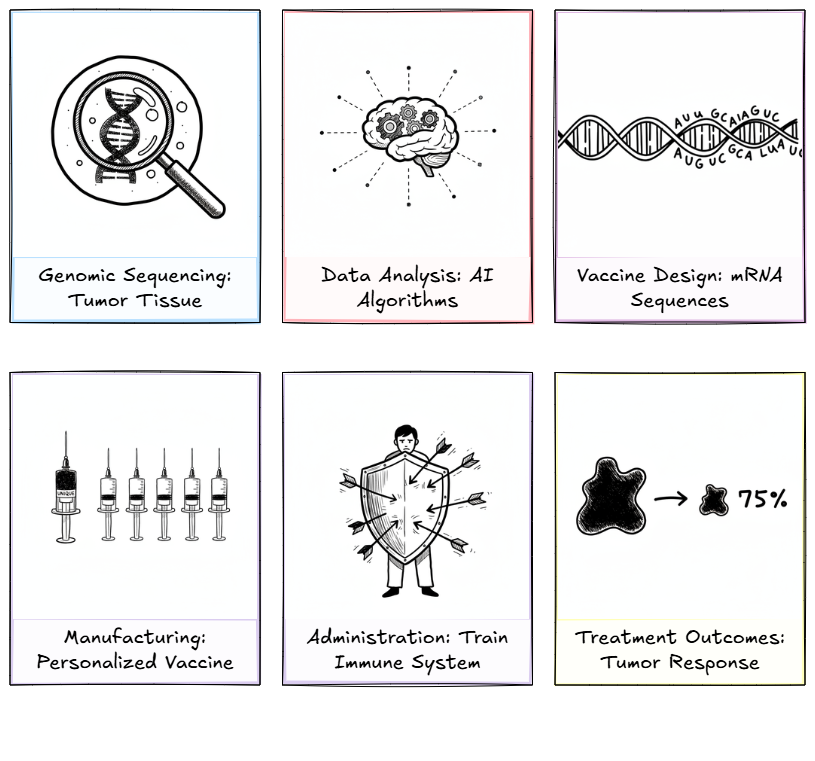
And then he did something absolutely unhinged. He sat down with ChatGPT. Analyzed 150 billion DNA letters from her tumor. Identified seven neoantigens. Designed a personalized mRNA cancer vaccine. At his kitchen table. Because the computational leverage was suddenly there — in his hands, available, executable.
UNSW RNA Institute manufactured it. Hit it with a checkpoint inhibitor. And then — it worked. Tumor shrinkage. Improved mobility. Not a cure, not a miracle. But undeniably, measurably working.
"Holy crap. It's working! Oh my God, it's actually working!" — that's what Conyngham said. You can feel the shock in those words. The disbelief. The moment when the impossible becomes possible.
This is the inflection point. The tools are here:
| Tool | What It Does | Accuracy |
|---|---|---|
| NetMHCpan & IEDB | Predict immunogenic epitopes | 90%+ |
| AlphaFold | Protein structure precision | State of the art |
| Immunostruct | 3D structural + biochemical integration | State of the art |
Moderna & Merck's mRNA melanoma vaccine reduced death and recurrence risk by nearly 50% over five years. This isn't a one-off. This is infrastructure. What worked on a dog in Sydney is pointing directly at what could work for you. The question isn't whether this scales. It will. The question is who gets in the door first — and who gets left standing outside.
Founder-Mode Cancer: Sid Sijbrandij's Personal War
Sid Sijbrandij, GitLab founder, got diagnosed with cancer and started treating his own disease the same way he treats a billion-dollar company — like a bug to be debugged, not a sentence to be accepted. A tech founder running his own cancer treatment like a product sprint. Not deferring to standard protocols. Not passively waiting.
Here's the pattern: tech leaders are treating their bodies as systems, not fates. Capital meets mortality, and suddenly disease becomes a failure mode — fixable, debuggable, addressable with the right resources and the right audacity. They're not asking permission. They're asking: what if I just... fixed this myself?
Bryan Johnson and the Theatre of Self-Experimentation
Bryan Johnson — the guy who sold Braintree to PayPal — is spending $2 million a year on himself. Not a house. Not a yacht. Himself. Hundreds of interventions. All documented. All public. His biological markers reportedly read like a 40-year-old who somehow negotiated a deal with time itself.
Is this vanity or the most efficient clinical trial design in history? It's probably both.
But here's the move that actually matters: the experiment IS the marketing. His brand, Blueprint, sells directly to the people watching him do it. He didn't just turn his body into a proof-of-concept — he monetized the audience. You're not buying supplements. You're buying a front-row seat to someone else's war against dying.
This creates a feedback loop that shouldn't exist but absolutely does. Visible experimentation pulls public attention toward the science. Public attention creates cultural permission for radical life extension. Cultural permission funds better research. Better research makes the experiments sexier. The cycle tightens whether we're ready for it or not.
The Enhanced Games: Where Biohacking Gets a Scoreboard
The Enhanced Games. A privately funded sporting event that does what traditional sports have always done in whispers — and says it out loud. This isn't the Olympics with a drug problem. This is the Olympics if it ever looked in the mirror.
| Aspect | Traditional Olympics | The Enhanced Games |
|---|---|---|
| Athletes | 10,000+ | Fewer than 100 |
| National representation | Core organizing principle | Doesn't exist |
| PED policy | Forbidden (tested, litigated, denied) | Explicit, documented, monitored |
| Data output | Hidden, proprietary, litigated | Published, peer-reviewed |
TEG's actual stated mission — "sports-based research grounds for technology- and science-driven human enhancement" — sounds insane until you realize it's just honest. Athletes get paid wages. Safety gets monitored. Outcomes get published. It's the same longevity and performance science the billionaires are funding in labs, except now there's a crowd watching it happen.
Chaos, Capital, and the Longevity Trade
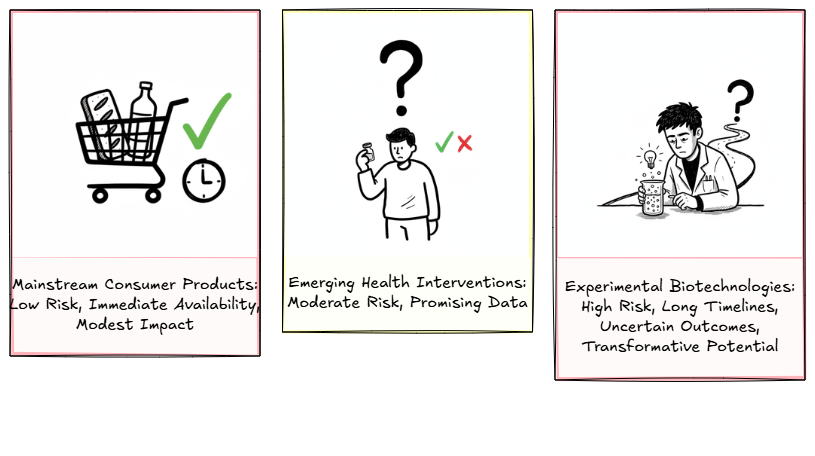
This isn't just science or spectacle anymore — it's capital recognizing the most asymmetric bet it's ever seen and moving in hard. Long timelines. Uncertain outcomes. The kind of wager that makes your accountant visibly age. But massive upside if it lands.
AI-driven drug discovery shrinking years into months.
The real money flows upstream — biotech, AI drug discovery, personalized medicine platforms. Things that still get laughed out of analyst calls. This is exactly the territory that attracts a certain breed of investor. Not your index-fund guy. The ones who actually like the volatility. They understand something fundamental: the biggest returns come from betting early on things that look completely deranged before they look obvious.
Here's the irony that keeps me up at night: the people funding immortality are betting with the longest possible investment horizon. They're not flipping these positions in three quarters. They're betting on forever.
So What Does It All Mean for the Rest of Us?
Q: Is any of this actually going to work?
Probably some of it. Moderna and Merck's mRNA data holds up. Rosie the dog is verifiably less sick. And five billion dollars doesn't move without smart money believing the plumbing actually works. The science isn't the question anymore. The question is scale — human trials, whether this translates from labs to bodies.
Q: Who gets access?
Rich people first. That's not cynicism — that's just the pattern. Every single time. The uncomfortable part nobody wants to say: by the time this trickles down to ordinary mortals, the real gains will already be baked into the stock price. Access inequality isn't a feature. It's the whole business model.
Q: Is Bryan Johnson actually younger or just exceptionally well-photographed?
The markers are real. The marketing is definitely real. And the line between them is deliberately, masterfully blurred.
Q: Should ordinary investors pay attention?
Yes. The market signal is undeniable.
| Metric | The Signal |
|---|---|
| Growth Rate | 21.5% CAGR |
| Market Size | $421B projected by 2030 |
| Timeline Compression | AI-driven drug discovery shrinking years to months |
Tech billionaires aren't betting on living forever because they're unhinged.
They're betting on it because for the first time in human history,
it doesn't look completely impossible.