The House Doesn't Cheat. It Just Built the Table.
And here I am — at the table. Not as a victim; I've made peace with that frame. But here as a witness to a pretty unhinged truth: the architecture of modern speculation has become so refined that it barely looks like architecture anymore. It looks like choice. Like freedom. Like a fair game.
Here's the uncomfortable truth we all ignore. The house isn't cheating. It built the table. It decided what games get played. What happens when you run out of chips. How fast the whole thing spins. The metaphor of a casino isn't just a Wall Street cliché everyone's heard a million times — it's a structural truth. The house advantage isn't a fraud. It's geometry. And once you see it that way, you can't unsee it.
Kalyug isn't a broken age. It's designed this way. So is retail speculation. It's not a bug. It's the product. It's the whole point.
That machinery has been surgically engineered. Each tool that's meant to "democratize" investing is also meant to keep you spinning the machine with quarters. Your quarters. Again and again. The odds aren't hidden or buried somewhere — they're written into the code. The architecture. But once you stop looking for fraud and start looking at structure, something shifts. Because the real question isn't whether the game is rigged.
It's whether walking away is even an option anymore.
The Numbers Don't Lie (They Just Don't Care About You)
And here's where the architecture jumps out. The table wasn't just built — it started to hum.
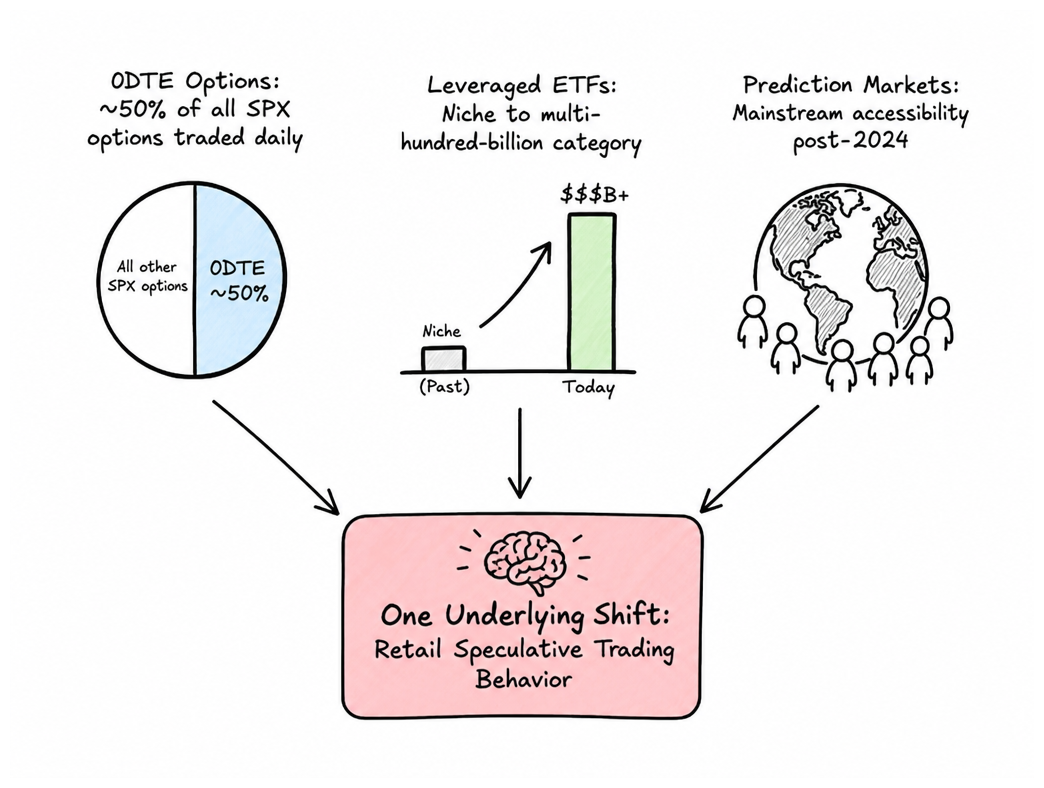
In 2022, Cboe enabled daily expirations. SPX 0DTE options became structural norm. Approximately half of all S&P 500 options traded daily now expire the same day they're bought. This isn't a spike — it's a business model shift. You wake up, there's a lever. By close, it disappears. Tomorrow? It is there again.
You would've assumed leveraged ETFs are still niche. But they're not. These 3x funds look like just another index on your brokerage app — the same one-click buy, the same interface. Except dramatically different physics. Here's the part almost nobody reads: that leverage resets daily — not cumulatively. The math gets brutal in sideways markets. But you don't see the fine print. You see the 3x ticker and your brain fills in the rest. Free money upside, right?
Prediction markets followed. Polymarket, Kalshi, PredictIt. After 2024, as a series of legal wins made prediction markets accessible to the broader public, the money flooded in like water finding cracks.
| Product | Entry Point | Resolution | The Hook |
|---|---|---|---|
| 0DTE Options | $50 to $200 per contract | End of day | Daily reset, instant feedback |
| Leveraged ETFs | $50+ per share | Ongoing | Hits like leverage, feels like stocks |
| Prediction Markets | $1 to $100 per contract | Event outcome | Priced like probability, feels like skill |
They're not three separate trends wearing different clothes. They're one pattern. One appetite. Three UIs scratching the same itch. The trend is not reversing. Each new cohort discovers these products and stays. The lever gets pulled because the lever was engineered to be irresistible.
Why Everyone Keeps Pulling the Lever
I'm starting to ask: why do these products feel so necessary once you know they exist? The answer might be simpler than you'd expect. These tools aren't just popular — they're downright irresistible. And I don't mean that metaphorically.
The dopamine hit arrives before you've even won. A 0DTE option expires in hours. A prediction market settles by tonight. You don't wait weeks for your thesis to play out. You get constant feedback, in near real time. And ease of entry ensures low premiums — you can make a bet for pennies. That low friction between thought and action? Your brain gets rewarded every few minutes, win or lose. The loss barely registers before you're already placing the next trade.
Prediction markets feel like a skill.1 They price probability instead of pure chance, which makes you feel like you have an edge — you're not just gambling, you're forecasting. The crowd prices things, and you can read the crowd better than the crowd can read itself. You can't. But the structure makes you feel like you might. Same with leveraged ETFs: they're stocks, same tickers, same app. Except they're moving at 3x speed, and speed feels like alpha.
The friction disappears. Zero-commission apps. $1 to start a prediction contract. $50 to buy a share of a leveraged ETF. No minimums, no commissions, no one standing in the way of your trade. Just you, the app, and a dopamine loop that was built before you even opened an account.
Each of these products taps into a shared bias: your overconfidence that you can anticipate the next few hours better than everyone else. The lever actually feels like control. Like steering. That's not by accident. It's the design.
How You Lose — Slowly, and Then All at Once
So you've got the lever in your hand. You understand the dopamine hit. You're pulling it daily. But here's the part nobody wants to think about until it's too late: the lever has teeth.
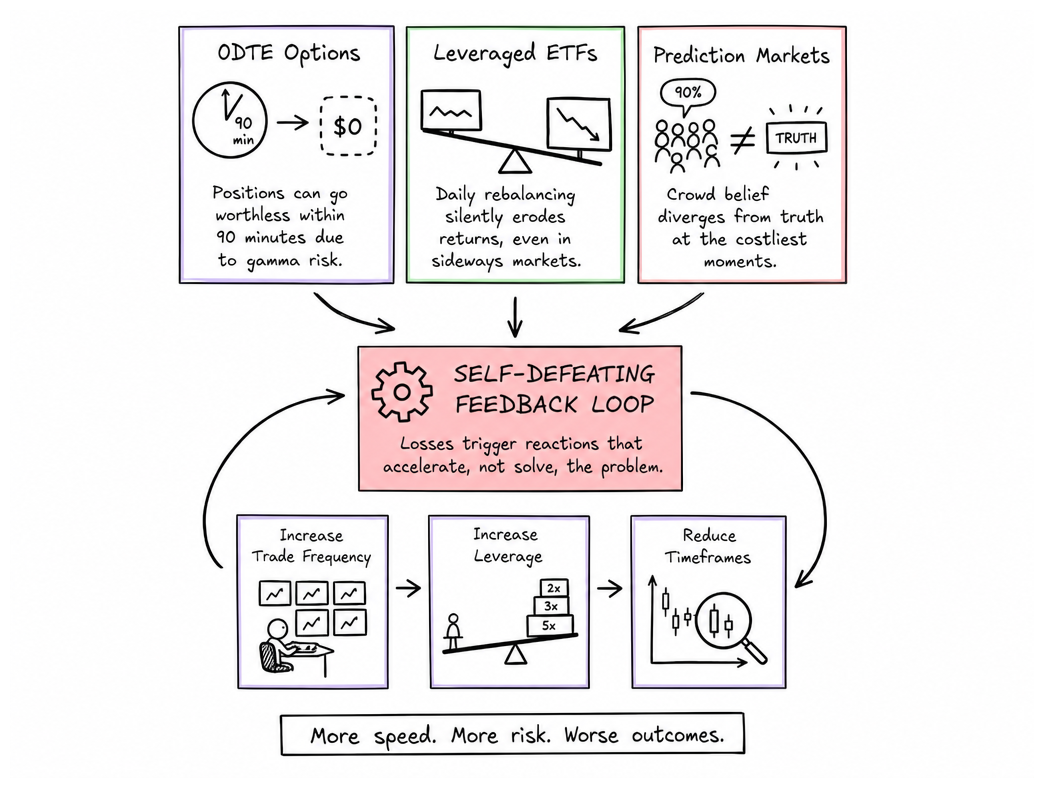
0DTE options can be worthless within 90 minutes. Not metaphorically. Literally. You're holding a position at 2 p.m., and by market close it's a ghost. But that's just the speed. The real damage is quieter.
3x leveraged ETFs technically deliver on their daily promise. Except that leverage resets every single day. Which means the market goes sideways for a month, ends flat — and you still lost. The calendar ate you. The math is working exactly as designed. Just not for you.
On top of that, prediction markets aggregate belief, not truth. Crowds get it wrong right when it costs the most to be wrong. Great design if you're the house. And volatility trading rewards consistency — the one thing retail traders bring instead is conviction. Like two different animals fighting in the same cage.
So what's the solution most people reach for? More trades. Higher leverage. Shorter time frames. Dial up the aggression, dial up everything. But that's not a fix. That's the accelerant.
| Instrument | The Trap | The Cost |
|---|---|---|
| 0DTE Options | Gamma swings + time decay | Worthless in hours |
| Leveraged ETFs | Daily rebalancing decay | Slow bleed on flat markets |
| Prediction Markets | Crowd belief ≠ crowd truth | Wrong when it matters most |
What's so ironically structural about this? The more short they fall, the harder you push into them. Faster dials on a machine already designed to extract. The question isn't whether you'll lose. It's just a matter of whether you want to lose quickly — and whether you notice while it's happening.
Kalyug Didn't Create This. It Just Named It.
There's a reason it's called Kalyug. It's not a brand. It's a diagnosis. A brutal one, if you're paying attention.
In Hindu cosmology, Kalyug is the age where dharma collapses and adharma becomes the operating system. Not as prophecy or doom-saying — as description. This is what it looks like when the old rules don't hold anymore. When trust evaporates. When everyone's playing a different game than they think they are.
This isn't a cyclical story of speculative trading exploding, then popping, then resetting. It's an ongoing, built-in story. Because the conditions that feed it are persistent: distrust of traditional finance (the Fed printed trillions; inflation hollowed out savings; institutions got richer while purchasing power died). Meme-speed information (a retail trader sees a trade idea and executes before the bots blink). And each generation inheriting the same instruments, but with better UIs and zero institutional memory. Your nephew doesn't learn from 2008 or the 2020 squeeze. He just opens an app and sees prettier charts and leverage he doesn't understand.
The speculative surge of 2020–2024 is not "correcting." It's compounding. More leverage. Shorter time frames. Tighter feedback loops. This is the operating environment now. There's an entire crowd that sees chaos not as an issue but as the whole damn point — building strategies, community, and education around exactly the volatility that makes everyone else run.
What This Means for the Rest of Us
While everyone's making noise, one thing gets buried: some people do win. They're just not playing the same game you are.
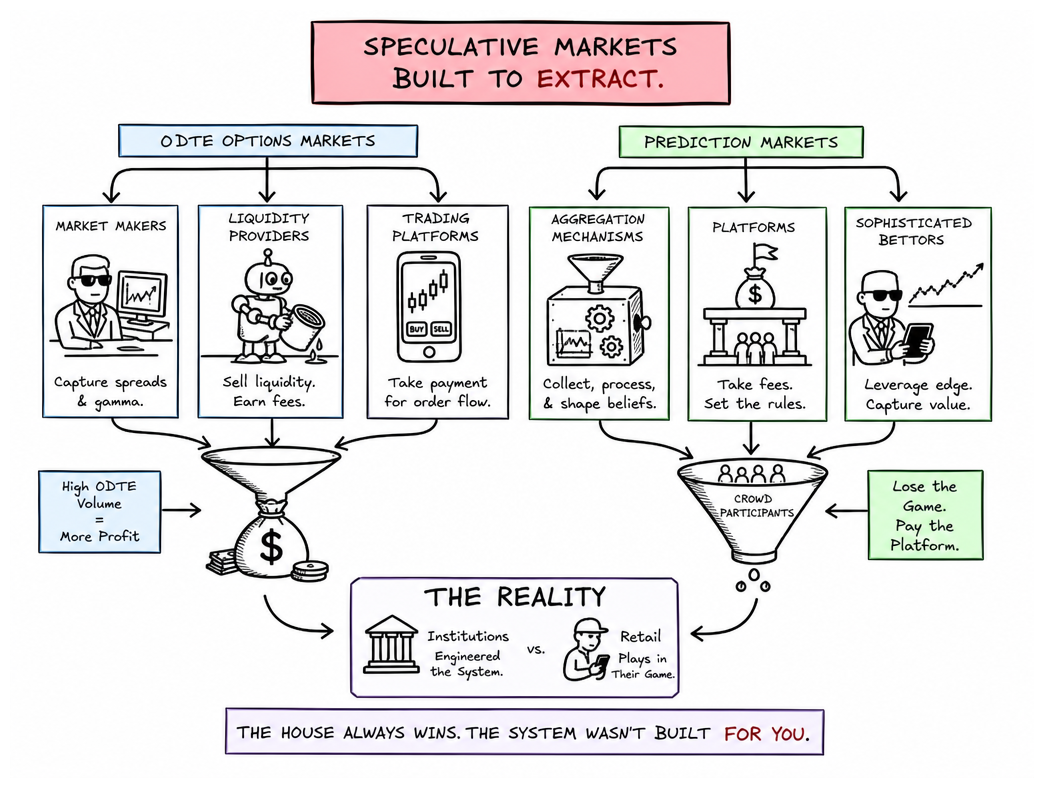
Liquidity providers. Platforms. Market makers. Unlike you, they don't have to be right — they just have to have you play. Because with each transaction, no matter if you win or lose, they skim off the top. The house always gets paid. Always. With prediction markets, the mechanism benefits the platform skimming fees and the people who knew before you did. Not the crowd. Never the crowd.
Just because you understand the architecture doesn't mean you stop playing. It means you stop pretending you're playing a different game than the one you really are.
You're not investing. You're not hedging. You're speculating against a table where the dealer takes a cut on every hand. This isn't pessimism. It's just reading the rules. The speculative opportunities are real. The question is who they're real for.
Don't take this as an exhortation to quit. It's just mapping the terrain — showing you where the value actually flows and asking whether you're positioned to catch it or just feed it. Understand who extracts and how. Understand that the game was built for certain players to win.
Then decide if you're one of them.
The Bet You're Already Making
Here's one reality no one likes to admit: whether you want to or not, you're already betting. Maybe your money sits in a dull index fund. Maybe someone is day-trading 0DTE options. Regardless, you're speculating. The difference is conscious versus unconscious. One person thinks they're being prudent. The other knows they're rolling dice. Both are rolling dice. One just sleeps better at night.
The house always wins because it built the table and wrote the rules. Every transaction made — market makers profit. Every bet placed — platforms earn. While everyone else churns, liquidity providers sip cream. That isn't a scandal. That's just the table. You didn't build it. You just sat down at it.
| What You're Betting On | The Illusion | The Reality |
|---|---|---|
| Index Fund | Safety through diversification | Unconscious chaos exposure |
| Leveraged ETF | Amplified returns | Daily reset compounding trap |
| 0DTE Options | Quick profit | Explicit market chaos |
| Prediction Markets | Skill-based forecasting | Paying the platform on every outcome |
0DTE options, leveraged ETFs, prediction markets — these aren't aberrations or perversions of "real" investing. They're the clearest, most honest expression of what markets actually are. Pure chaos. Pure speculation. No pretense. No comfort.
The question isn't whether you play the game. It's whether you'll read the table before you sit down. Or whether you'll know what game you're truly playing. That's all. Just read the terms.
Adharma is the only alpha that never lies. — Kalyug Capital