The Fortress Thesis: Owning the Chokepoints
Here's what separates the compounders from the one-hit wonders: the best businesses don't just win markets — they own mandated, irreplaceable chokepoints. A great company sells you something you want. A fortress company sells you something you have no choice but to buy — legally mandated, impossible to swap out, and baked into how the whole operation runs.
The five picks share three defining traits: regulatory moats so deep that competitors need years and millions just to knock on the door, captive customers with zero switching costs once you're in, and recurring cash flows that don't depend on the next big product launch. Not flashy. Just inescapable.
| Company | Ticker | Chokepoint Owned |
|---|---|---|
| Palantir | PLTR | The operating system of the state |
| Axon Enterprise | AXON | The infrastructure of enforcement |
| TransDigm | TDG | The aerospace aftermarket toll booth |
| Rocket Lab | RKLB | The small-sat launch layer |
| AeroVironment | AVAV | The consumable of modern war |
You'll also see four names on the bench — Verisign (VRSN), FICO, Kratos Defense (KTOS), and Moody's (MCO) — that carry identical chokepoint DNA but aren't quite roster-ready yet. For the full framework behind fortress wealth and why chokepoints matter more than market share, we lay it out in the Fortress Wealth thesis. But this is where we're headed: the companies that own infrastructure nobody else is allowed to touch.
PLTR — The Operating System of the State
At its core, Palantir's task is straightforward — connect government data sources, no matter how dispersed or disconnected, to help decision-makers see patterns in real time. But it's not that simple in practice. They built three core products — Gotham for defense and intelligence, Foundry for commercial data, AIP for AI applications — but here's the thing: the products themselves aren't the moat. The moat is the clearance stack.
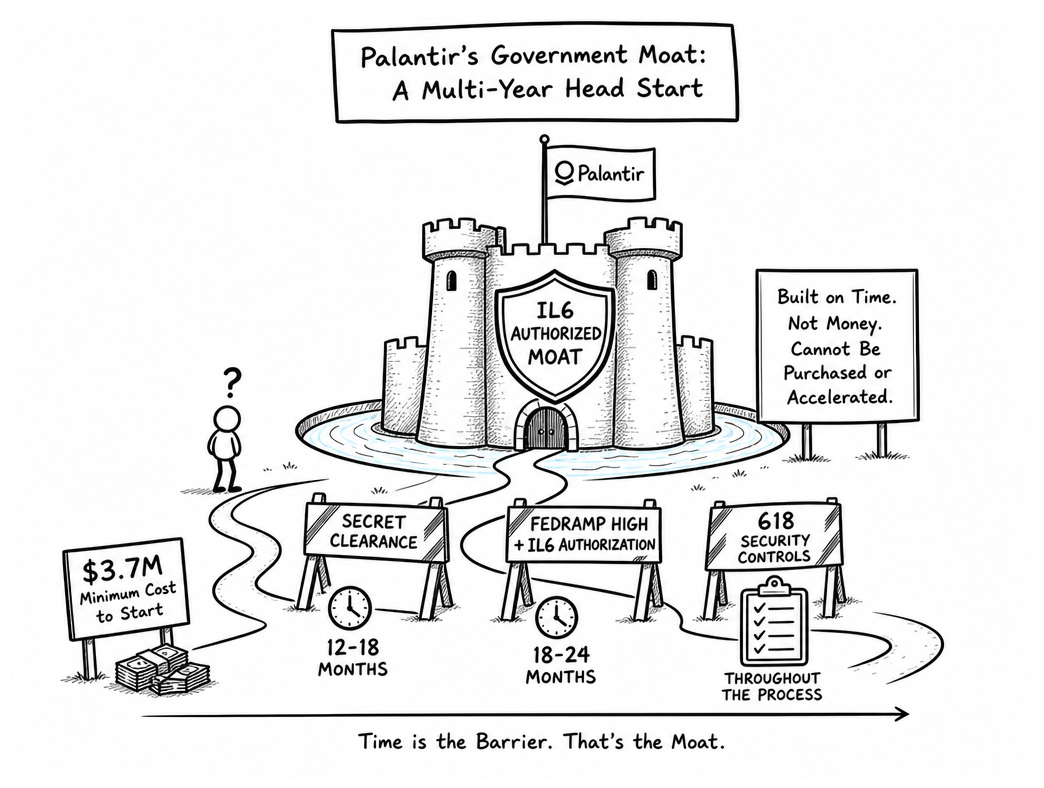
When it comes to getting into the game, it's not just about tech or money. It's about time.
If you want to compete with Palantir for classified government work, you'll need Impact Level 6 (IL6) authorization — which means meeting 618 security controls. A SECRET clearance alone can take 12–18 months. A FedRAMP High certification at IL6 can take 18–24 months and cost as much as $3.7 million just to start competing. Money won't get you into the room — you'll have to wait. IL6 isn't a certification so much as a decade-long waiting room.
So what does that mean for a rival? When Palantir is integrated into the fabric of a department, disconnecting from it means restarting the clock on authorizations. That's a delay no CIO wants to walk up to their boss. That's the real lock-in — not the contract. Palantir doesn't own the customer; it owns chokepoints:
| Product | Purpose | Lock-In Driver |
|---|---|---|
| Gotham | Defense and intelligence | Classified workflows |
| Foundry | Commercial customers | Data infrastructure depth |
| AIP | Generative AI on existing data | Workflow integration |
Worth noting: Palantir's work with the Department of Defense, ICE, and the Israeli military draws consistent criticism over surveillance and data weaponization. That's part of the thesis too — chokepoints aren't always comfortable to own.
The stock just came off its base, which makes it the freshest entry point in this group. Here's why that timing matters.
AXON — The Monopoly of Enforcement
While Palantir helps intelligence agencies connect the dots, Axon owns the entire infrastructure of physical enforcement. Yes, Axon makes TASERs and body-cams — but that's not the business. The business is the cloud platform that stores, processes, and serves back every piece of evidence a police department generates. Once you're on it, you don't leave.
How the dominance breaks down:
- 85% market share in body cameras among major US police departments
- Evidence.com processes 30M+ uploads per month — that is the chokepoint
In 2024, Axon crossed $1.0 billion in annual recurring revenue, up 37% year-over-year — pure software economics wearing a hardware company's clothes.
So why can't departments switch? The cost of switching isn't a budget line item — it's the cost of operational chaos. They'd need to retrain every officer in every department, absorb the fallout of breaking workflows that have become muscle memory, and spend months migrating years of archived footage. It's a career risk: thousands of people, thousands of hours, and months of downtime that nobody wants to own. So they don't switch. They can't afford to — even if they wanted to.
Total revenue hit $2.08 billion in 2024 — the third year in a row of 30%+ growth. Axon went from a stun-gun company to a recurring-revenue machine that just so happens to also sell stun guns — a company that can barely be disrupted because every police department in America depends on it. Which begs the question: who else has embedded themselves so deeply that no one can switch out?
TDG — The Aftermarket Toll Booth
I just showed you how lock-in works at the enforcement layer. Now flip the perspective — what if you own the parts that keep an entire system functioning?
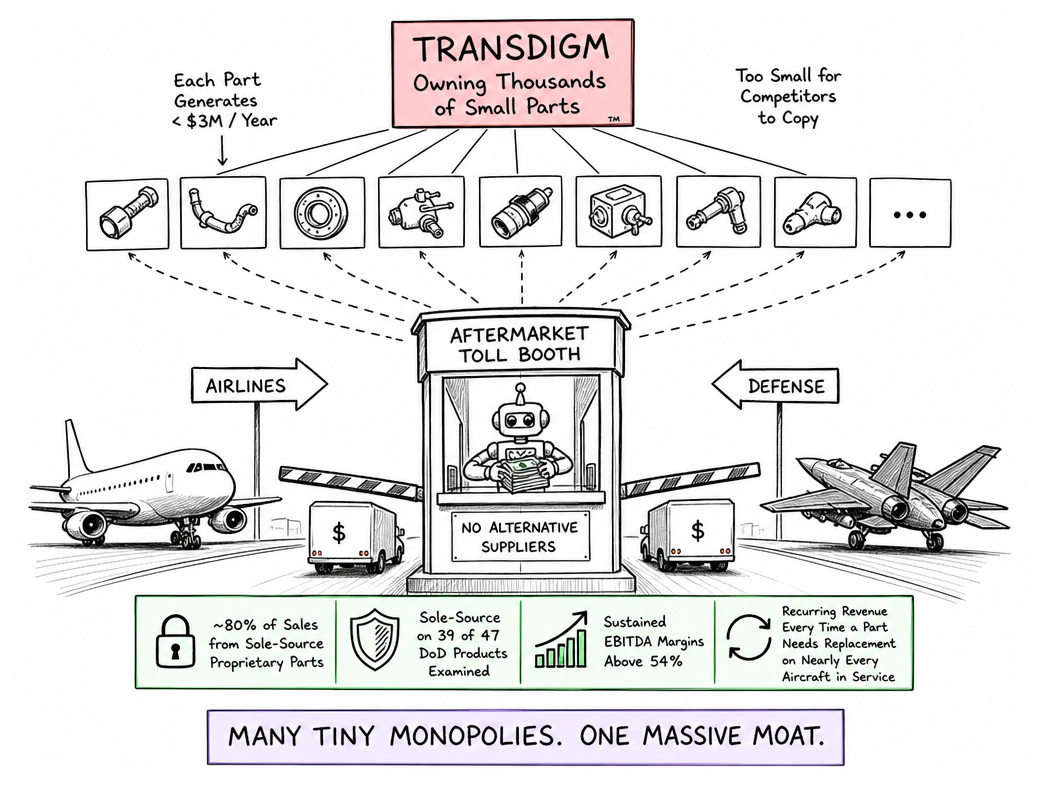
Every commercial and military aircraft in service today contains a part made by TransDigm. The company was started in 1993 through a leveraged buyout of four industrial businesses, and has grown ever since via disciplined acquisition. The simplified version of how it works:
- Over 80% of sales come from proprietary, sole-source parts — most selling for less than $3M per year
- Sole source on 39 of the 47 DoD items studied — components of the F-16, the Apache, and dozens of other platforms
Once you've specced a part into an aircraft design, you don't switch suppliers. Switching means redesigns, recertification, delays — and no one does that to save a few bucks on a multi-million-dollar part. Airlines and defense contractors are captive, and they pay the toll every time a plane flies.
In three quarters of FY2025, EBITDA margins were 54% or higher — the line that matters.
What that signals is not cyclical aerospace noise, but durable, recurring revenue. I keep coming back to it because it's exactly what you want in a defense-adjacent holding: boring, stable, and utterly indispensable. No growth fireworks, no viral moments — just a company that owns the aftermarket on every platform that matters.
TDG is the gravitational anchor of this portfolio. It never breaks. It's far from the headline velocity of a PLTR or the acceleration of a RKLB, but it's the piece that keeps every plane aloft — and the company that owns it.
Next up is velocity: companies that accelerate the cycle rather than tax it.
RKLB — The Launch Layer
Zoom out: TransDigm owns the parts that never leave the ground, and Rocket Lab owns the infrastructure that gets everything into orbit. Of the two, RKLB is the only investable half of the small-sat launch duopoly. While SpaceX dominates the heavy-lift tier, RKLB is the only publicly-traded pure-play in the small-satellite constellation and defense launch market.
The Electron rocket isn't the moat — the reliability track record is. Eighty-three launches, seventy-nine successes. That's a structural advantage. Why? Your payload customer is a defense agency or a constellation operator. You can't have a failed launch. You can't afford to re-certify a new vendor. Once you're locked into a launch provider that doesn't lose payloads, you don't swap.
Predictability is stickiness.
The Electron's specs are right-sized for this exact customer base: 200 kg to a 500 km sun-synchronous orbit — precisely the weight class defense and constellation customers need. Small, frequent, dedicated launches beat waiting in a rideshare queue. It's a different game than Falcon 9.
Here's where the moat deepens: the HASTE hypersonic test vehicle opens a classified defense revenue stream competitors haven't broken into — with 100% DoD mission success. This is no longer hope-for-launches; it's already booked.
- $816 million defense backlog locked in
- Not a future hope — already a paying-customer reality
This isn't a hop-and-hope sprint, and it's already extended hard. Buy the pullback.
Next, the consumable layer — a weapon you get to fire, not maintain.
AVAV — The Consumable of Modern War
Owning the launch layer means you own the infrastructure. But owning what actually gets consumed — what gets launched and fired — means you own something more immediate. That's AeroVironment's play. The Switchblade loitering munition isn't a decadal platform like an aircraft or a submarine. It's the drone world's bullet — and bullets get consumed.
LMS revenue hit $52 million in Q1 FY2025, up 68% year-over-year.
That wasn't just a good quarter; it's a sign of adoption moving from the battlefield to the books. When a weapon system proves itself across multiple allied countries and conflict theaters, reorders shift from nice-to-have to structural. In October 2024, the Pentagon increased the Switchblade contract ceiling by $743 million — the state signaling it expects to keep buying.
Consumables are strange. The other fortress chokepoints in this report are platforms — you pay once, integrate them, and they're in your stack for years. Switchblade is fired, it's gone, and you buy more. No one trials an unproven munition in the middle of a serious firefight. Once Switchblade has proven itself — which its revenue growth says it has — there's no switching cost, because there's nothing to switch from. Just keep buying ammo.
Position sizing here isn't a bet on a platform cycle — it's a bet on a consumable that compounds. We've sized AVAV for RAHU-tier torque: the highest asymmetric upside if and when the drone-war thesis keeps accelerating. If loitering munitions become the standard precision layer of modern conflict, reorder velocity compounds faster than any platform ever could.
The Bench: Same DNA, Not Rostered Yet
The fortress thesis doesn't start and stop with five names. There's a second tier with the same chokepoint DNA, playing a different timing game.
| Ticker | The Chokepoint | Why It's Not Rostered |
|---|---|---|
| VRSN | Government-granted sole operator of the .com registry — every .com passes through its toll booth, zero competition by regulatory design | Real pricing power, but doesn't fit the entry timing yet |
| FICO | The credit score the mortgage industry is required to pull — can't opt out, can't be replaced without an act of Congress | Textbook chokepoint, but you're buying a utility: steady, boring, slow |
| KTOS | Low-cost jet drones — earlier stage, right thesis | Watching the contract cadence before pulling the trigger |
| MCO | One half of the regulatorily-required ratings duopoly — regulators mandate its use, which forces its pricing power | A classic fortress, waiting to be walked into at the right price |
Wired like chokepoints, but not aligned on entry timing or confirmation. Keep an eye on these — just don't add them to the roster yet.
Portfolio Construction: The Barbell
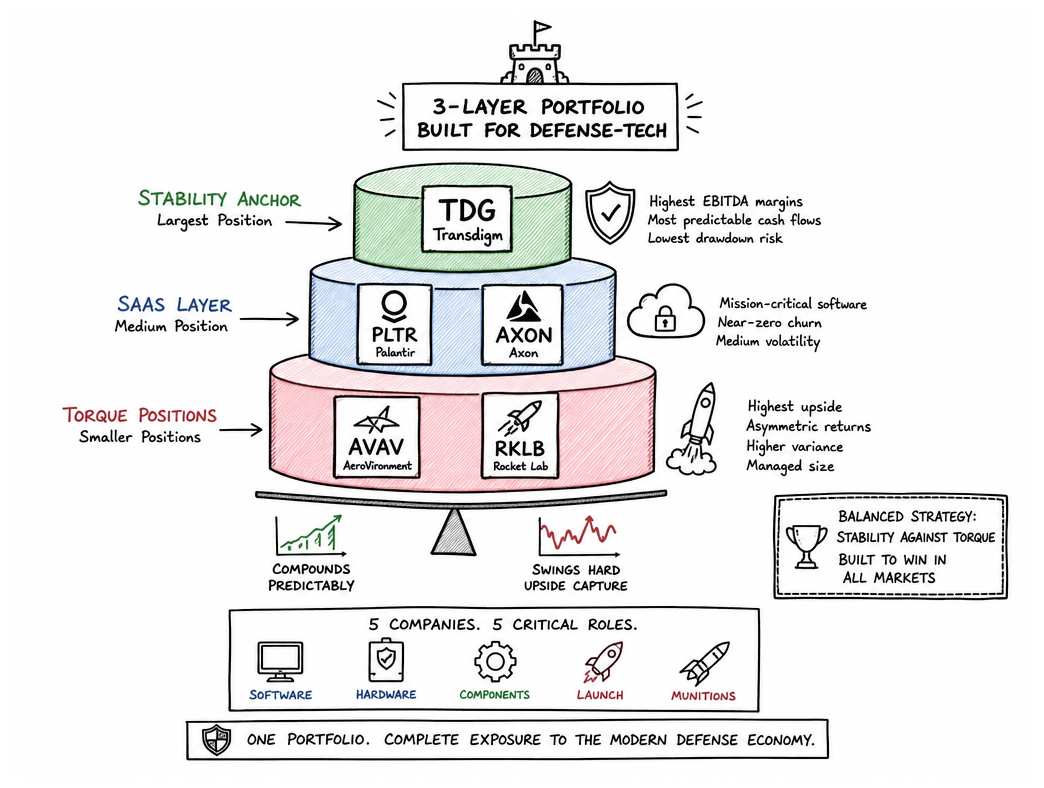
These five positions rhyme — chokepoints, regulatory moats, cash generation — but you can't own them all the same way. Construct a barbell: stability anchoring one end, torque swinging on the other.
- TDG — the most stable piece: highest EBITDA margins, most predictable cash flows, lowest drawdown risk. This is the largest position.
- PLTR and AXON — the SaaS layer: mission-critical software, steady growth, near-zero churn. Medium weight, medium volatility. They quietly compound.
- AVAV and RKLB — highest variance, highest upside torque. Sized smaller than PLTR and AXON so a 50% drawdown doesn't crater the book, but big enough to move the needle if their theses accelerate (ramped defense spending, supply-chain fragmentation, peer conflict).
Five positions across launch vehicles, hardware, components, software, and munitions — mutually exclusive exposure. Own TDG if you can only own one. Own all five and the barbell does the work: one compounds; the other swings hard when it matters.
Frequently Asked Questions
Follow the rent, not the flag. The primes still build the airframe, but the margin, the pricing power, and the lock-in migrated to whoever owns the software, the aftermarket, the launch pad, and the consumable. These five sit at chokepoints the incumbents can't dislodge — and the state either mandates them or can't function without them. That's the whole thesis: own the toll booths, not the traffic.