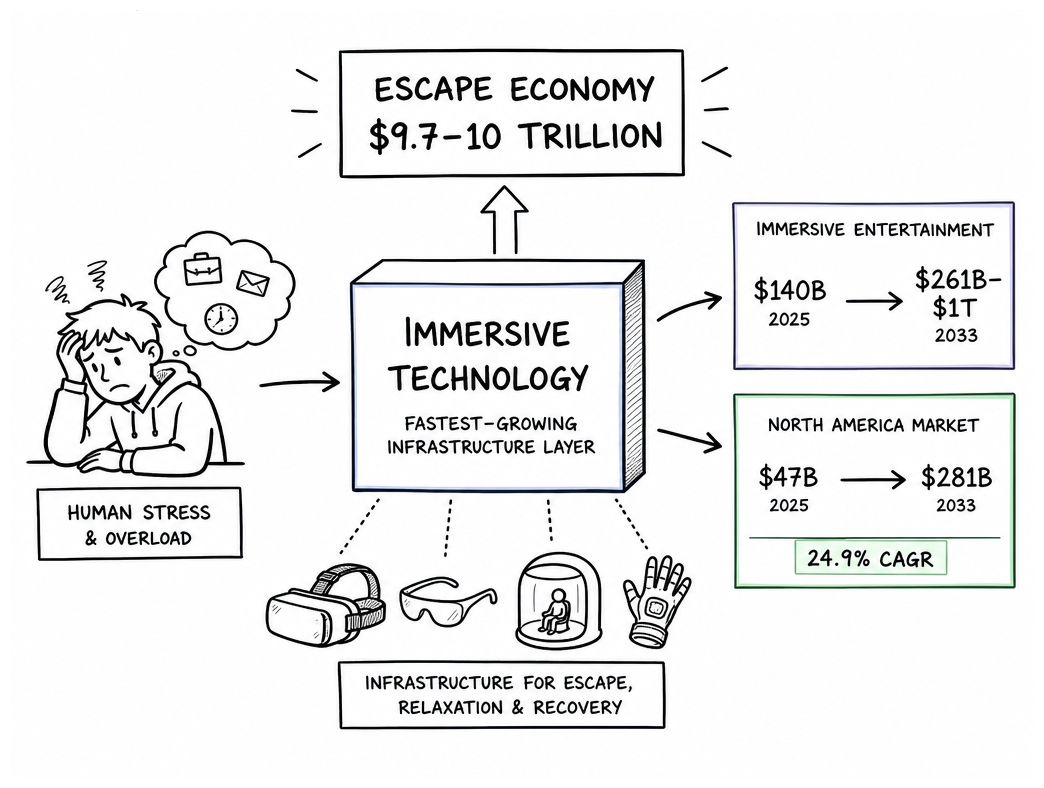
The escape economy is real. It's a $9.7–$10 trillion sector modeled entirely around stress-relief, identity, and the compulsive need to be somewhere else. In 2025, immersive entertainment alone is a $140 billion industry. By 2033, it could be worth $261 billion — or as much as $1 trillion, depending on which forecast you trust.
| Market | 2025 | 2033 | CAGR |
|---|---|---|---|
| Global Immersive Entertainment | $140B | $261B–$1T | Variable |
| North America | $47B | $281B | 24.9% |
Those forecast bands aren't just noise — they're the spread through which a trader makes money. The escape economy and immersive technology are the same story. The companies that own that story will likely capture outsized returns as the two markets converge.
The Four Questions We Asked About Every Company
There's an entire sector technically worth trillions — and most of it isn't vapor and hype. But there's also plenty of vapor. We narrowed the universe down using four hard filters:
- Strategic Vision — A coherent spatial computing or immersive platform thesis that makes sense beyond the current cycle. Not a pivot. An actual roadmap.
- Competitive Moat — What makes this company structurally difficult to displace? Platform network effects? Developer ecosystem control? Hardware lock-in?
- Execution Track Record — User growth, revenue milestones, product launches. Evidence. Not promises. Truth lives between what a CEO says on an earnings call and what actually ships.
- Financial Health — Balance sheet strength, path to profitability, cash flow discipline. A beautiful vision that eats cash and never pays rent is still a bad trade.
The portfolio construction logic: three large-caps for ballast, two mid-to-small caps for asymmetric upside. Different risk profiles, same civilizational bet.
#1 Meta Platforms (NASDAQ: META) — The Metaverse Company That Still Has the Keys
Meta is the only company currently willing to burn billions on the bet that spatial computing becomes the next computing paradigm. Reality Labs continues to own the consumer VR hardware stack with Quest, while Ray-Ban Meta glasses quietly become the most-worn smart glasses in history.
| Competitive Moat Element | What It Does | Why It Matters |
|---|---|---|
| Largest installed VR user base | Lock-in through network effects and content library | Users don't switch headsets lightly — sunk cost in library and social graph |
| Horizon Worlds social platform | Sticky, reason-to-return social layer | Social graphs are hard to rebuild elsewhere |
| Developer ecosystem (100+ $1M titles in 2025) | Real money flowing to creators | Developers build where the users are — flywheel compounding |
That's the lock. Once spaces become lived in by users or shipped by developers, moving them creates friction incarnate. Reality Labs reported a $4.03 billion operating loss in Q1 2026 — but Meta's core advertising business printed $56.3B in revenue the same quarter. The losses are being absorbed by a cash machine. No other company can afford to play this long game at this scale.
This is why Meta dominates the list. It's not that Quest is transcendent — it's good, functional, iterating fast. But Meta is the only company funding a genuine 10-year platform transition while simultaneously growing one of the most profitable ad businesses in history.
#2 NVIDIA (NASDAQ: NVDA) — The Infrastructure Layer Every Immersive World Runs On
Meta owns the headset. Apple owns the brand. But NVIDIA? NVIDIA owns the physics.
Every single immersive experience — every metaverse, every AR overlay, every digital twin, every spatial computing environment — runs on real-time 3D rendering. And when it comes to scalable, real-time 3D rendering, no one else comes close. The competitive moat here borders on religious.
For FY2025, NVIDIA's Pro Vis segment hit $1.9B in revenue, up 21% year-over-year. That's the official spatial computing footprint. The actual exposure sits deeper in the stack — 84% of developers building for XR use NVIDIA hardware.
- 71% of XR adopters say AI makes onboarding easier — NVIDIA provides both the AI infrastructure and the rendering stack
- Developers who build spatial apps need generative AI for user behavior prediction and content generation — same GPUs, dual purpose
- The company owns the entire supply chain from training to inference to rendering
- North American spatial computing market: $43.3B — NVIDIA gets direct exposure without the consumer hardware risk
The risk: if you don't keep up with the compute curve, the empire cracks. But NVIDIA has now been ahead of the compute curve for four consecutive architectural generations. The moat widens with each one.
#3 Apple (NASDAQ: AAPL) — The Spatial Computing Brand With the Highest Floor
If NVIDIA is the pick-and-shovel play, Apple is the one rewriting what the shovel is supposed to dig. Apple didn't call Vision Pro a VR headset. They called it a spatial computer — and that framing distinction is doing a lot of work.
"With Apple Vision Pro, we're defining the possibilities of spatial computing's emerging new era." — Apple VP Mike Rockwell
Vision Pro may be at the premium end of the immersive tech stack — but just because it's premium doesn't mean it's niche. Apple's history is a repeating story: introduce at premium, iterate fast, collapse the price curve, capture mass market. iPhone. AirPods. Watch. The pattern is not subtle.
Enterprise use cases are already validating the thesis. JigSpace and others are shipping spatial computing enterprise tools on Vision Pro that combine spatial anchoring with collaborative multi-user environments. The performance lead grows while the price comes down.
The risk: cost, bulk, and the smartphone already being "good enough." Consumer adoption friction is real. But the bet isn't on consumers strapping Vision Pro to their faces tomorrow — it's on a computing paradigm shift over 5–7 years. Apple's brand trust and developer ecosystem make them the highest-floor play on that timeline.
#4 Roblox (NYSE: RBLX) — The Mid-Cap Metaverse Already Running at Civilizational Scale
You have your headset manufacturer, your infrastructure layer, your spatial computing play — but here's the actual metaverse that's already running: 380 million monthly active users by end of 2025. Not a projection. A reported number.
Here's where things structurally get wild. Roblox creators earned over $1.5 billion in 2025 — and this isn't passive income. It's an economy. Developers, designers, experience builders — all paid in a real economic loop that reinvests back into platform growth.
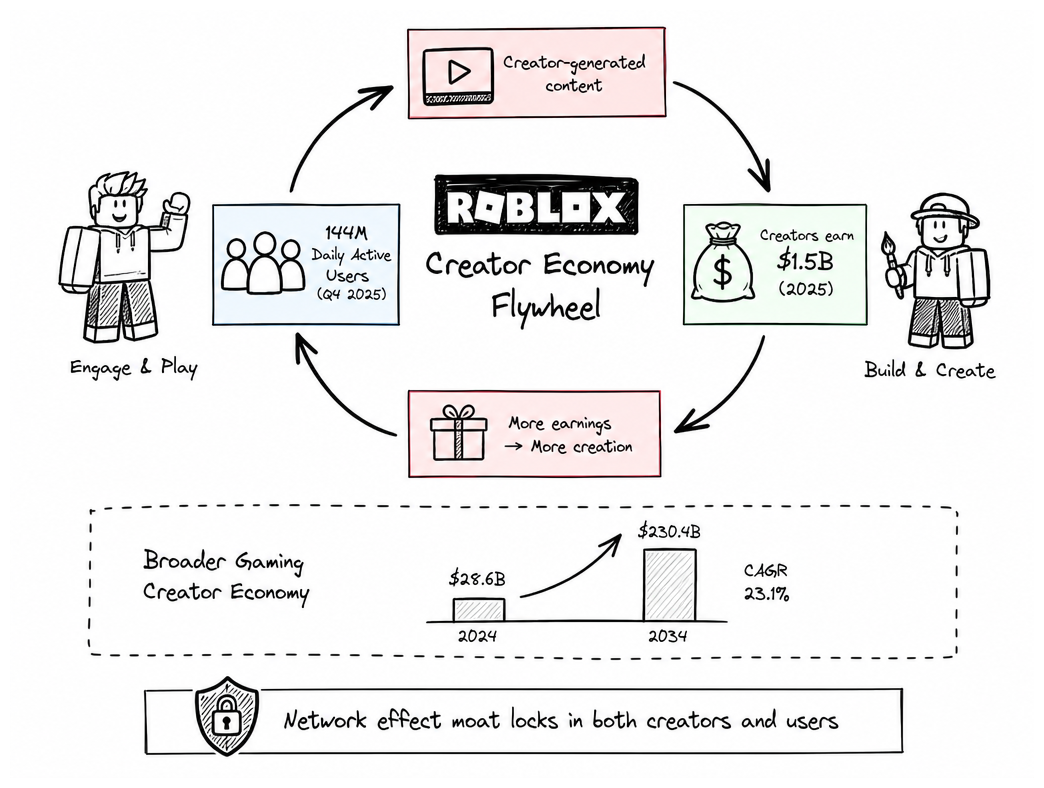
Revenue hit $4.9 billion in 2025, with bookings growing 55% year-over-year to $6.8 billion. The gaming creator economy is worth $28.6 billion today and is expected to grow to $230.4 billion by 2034.
This is the direct equity expression of the escape economy — not the infrastructure or hardware. It's the experience that captures human attention at scale, today, in real time. The risk: mid-cap valuation compression if monetization per user doesn't scale with user growth. But at 380 million MAUs, the platform risk is lower than it looks.
#5 Unity Software (NYSE: U) — The Small-Cap Tool Powering the Immersive Stack
This is where the real leverage lives — and the least institutional attention. Unity is $12.3 billion. Smallest of the five. But structurally? It's the skeleton key. While Meta, Apple, and NVIDIA fight over the hardware layer, Unity quietly powers the content layer.
The moat Unity built is silent and brutal: developer lock-in. When you build a product in Unity for two years, you're not switching engines. The switching cost is the entire codebase. $33.4 billion — that's the value of the VR/AR creator economy that builds on Unity's stack.
Unity doesn't care which headset wins. It collects rent on the content regardless.
The execution caveat: Unity recently transitioned its business model, creating headwinds. The runtime fee controversy burned trust with developers. The recovery is in progress, not complete. High risk, but the structural thesis remains intact — if any hardware platform wins, Unity benefits from the content explosion that follows.
Escape Economy Signal That Most Investors Are Still Misreading
Honorable Mentions: Two More Names Worth Watching
If you want direct exposure to the immersive tech thesis without institutional weight, two names sit further down the risk curve:
Matterport (NASDAQ: MTTR) — A play on owning a piece of the mid-tier spatial computing infrastructure. Digital twin technology at enterprise scale, increasingly critical to real estate, construction, and industrial XR deployment.
The Glimpse Group (NASDAQ: VRAR) — The pure speculation end. A portfolio company holding multiple immersive tech studios, each with its own thesis. Total optionality play, not a conviction position.
| Metric | Matterport | Glimpse Group |
|---|---|---|
| Market Cap | $1.76B | ~$14M |
| Business Model | Infrastructure play | Portfolio + optionality |
| Risk Profile | Execution-dependent | Philosophy-dependent |
| Entry Point | Institutional-adjacent | Pure speculation |
To Sum It Up: Five Layers, One Civilizational Shift
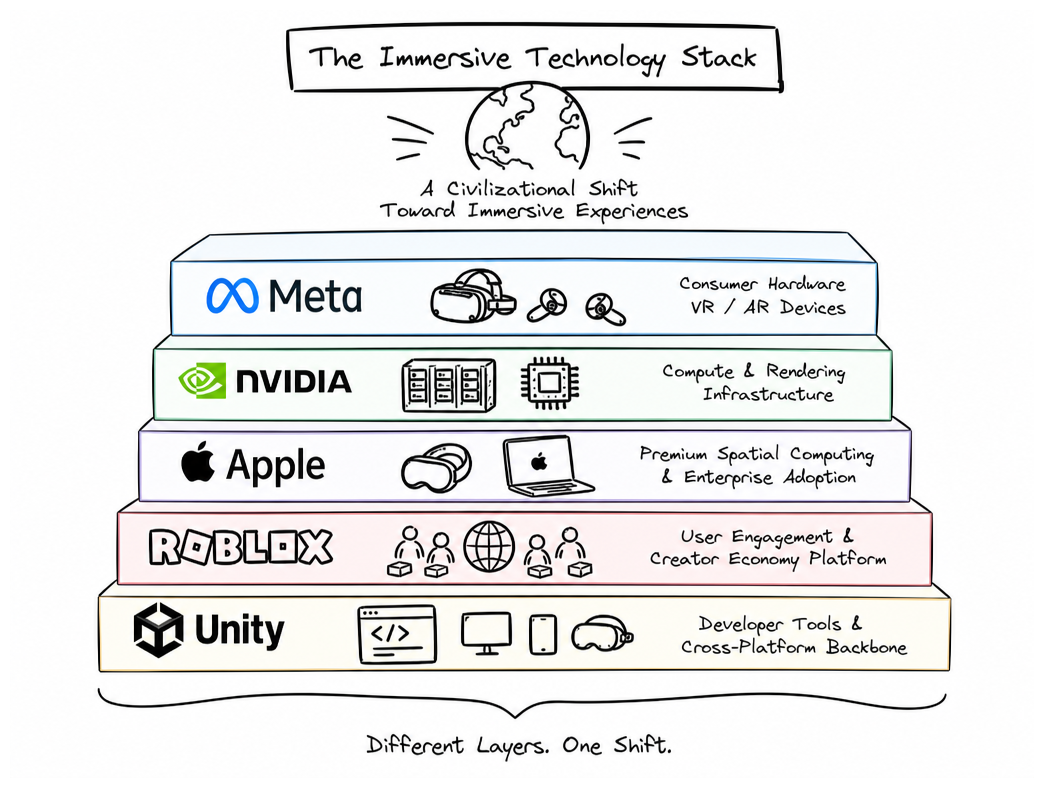
Meta owns the consumer hardware layer. NVIDIA owns the compute backbone. Apple owns the premium brand with the highest floor. Roblox owns the engagement economy running at scale today. Unity owns the developer tool layer that wins regardless of which hardware platform survives.
| Company | Role | Risk Profile |
|---|---|---|
| $META | Hardware + platform | Heavy execution risk, deep pockets |
| $NVDA | Compute infrastructure | Stable, moat widens each generation |
| $AAPL | Premium spatial brand | Adoption timeline risk, highest floor |
| $RBLX | Engagement at scale | Monetization-per-user risk |
| $U | Developer tool layer | Platform risk, trust recovery in progress |
The $13.9 trillion forecast by 2028 isn't a wishlist — it's the math of what happens when human attention migrates to immersive platforms and capital finally follows. The gap between where attention already is and where capital currently sits is the trade.