The Uncomfortable Truth Hidden in Consumer Spending
Here's the thing: people are leaving. They're still physically at work, scrolling their feeds, and pretending everything's normal. But their attention, their money, their time? They're leaving. And we can now measure it.
In 2025, the global immersive entertainment market was valued at approximately $140 billion. This is no rounding error. It's the structural demand for immersive experiences — as people opt to spend their vacation day and evening budgets on VR parks, immersive clubs, live-action gaming venues, and metaverse experiences.
Here's where it gets weird: the projections swing wildly. One group of analysts projects it to hit $261 billion by 2031. On the other hand, some see it surpassing $1 trillion by 2033. Both numbers feel insane and inevitable at the same time. But these wildly varying assumptions aren't confusion — it's speculative territory. It's the kind of frontier where fortunes get made by people willing to bet on which vector wins.
The game has evolved. It's about how modern consciousness allocates itself. It's about where the money flows when reality stops feeling like home. And where the money flows, alpha generation follows.
Ok… But How Big Is the 'Getting Out of Here' Economy?
This isn't hobby money. This isn't a rounding error in the entertainment budget. People are actually leaving — and leaving in ways we can quantify. In ways that show up in quarterly earnings and market projections. The velocity itself is the confession.
| Segment | 2024–2025 | Projection | Growth Rate |
|---|---|---|---|
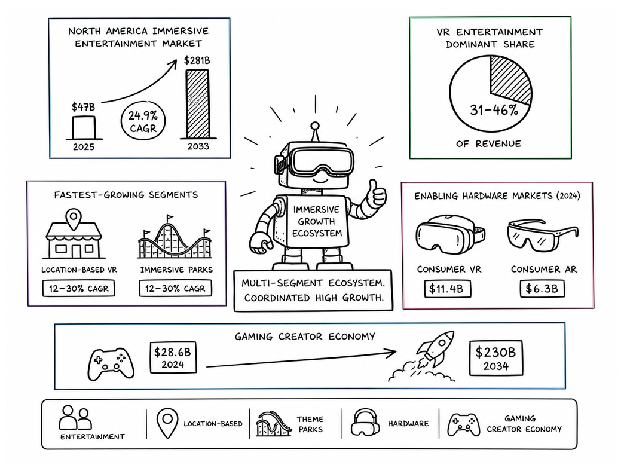
| North America immersive entertainment | $47B (2025) | $281B (2033) | 24.9% CAGR |
| Consumer VR hardware | $11.4B (2024) | — | — |
| Consumer AR hardware | $6.3B (2024) | — | — |
| Gaming creator economy | $28.6B (2024) | $230.4B (2034) | 23.2% CAGR |
Hardware is the pick-and-shovel layer. $11.4 billion in consumer VR shipments and $6.3 billion in AR build the foundation — every dollar of immersive infrastructure shipped is a tether. And this is before the headsets get cheap.
VR and themed entertainment make up 31–46% of segment revenue. But the fastest acceleration? Location-based VR venues, immersive parks, live gaming — all running at 12–30% CAGRs. People aren't buying headsets to sit alone in their bedroom. They're paying to go somewhere. To be with the escape, not just in it.
The gaming creator economy — $28.6 billion in 2024, projected to $230.4 billion by 2034 — is the layer where escape becomes a living. Attention turns to infrastructure. Infrastructure turns to more creators. And so on.
Real question: how long before this stops looking like a market and starts looking like an infrastructure?
Time Is the Real Currency — And People Are Spending It Elsewhere
Why does this matter? Because money is what's left over from the hours. Never the other way around.
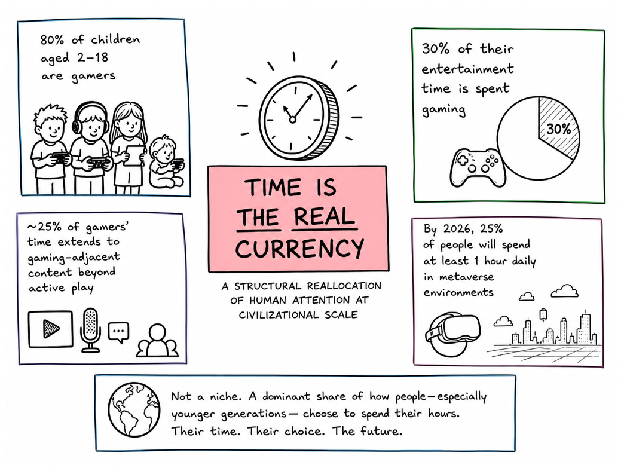
Nearly 80% of 2–18 year olds are gamers, spending 30% of their entire entertainment time on games. That's not a hobby. That's a wholesale migration. And it doesn't stop at 18 — adults are spending nearly one quarter of their entertainment time on gaming-adjacent content: commentary, streaming, lore deep-dives. The experience expands. Nobody told it to stop.
Then Gartner throws out this number: by 2026, 25% of people will spend at least one hour daily in the metaverse. One hour. Every single day. That's not fringe. That's mainstream behavior, baked into the schedule.
| What's Happening | The Implication |
|---|---|
| 80% of kids gaming 30% of entertainment time | Attention isn't distributed — it's consolidated |
| Adults consuming 25% of time on gaming-adjacent content | The escape doesn't end. It evolves. |
| 25% of people spending 1+ hours daily in metaverse by 2026 | This is baseline behavior now, not novelty |
Here's the painful truth: this is competition for hours, not dollars. For every minute spent in a virtual environment, a minute of something else has not happened. Zero-sum. And the escapists are winning. When you have someone's hours, you have their purchasing power — for digital goods, subscriptions, and cosmetics that don't physically exist.
When attention shifts at this scale, it doesn't trend — it calcifies. Revenue models ossify. The chaos produces durable shifts, not cycles.
XR: The Hardware Race Nobody Can Afford to Lose
Attention moves — but what holds it in place? Hardware. You can't think your way into a metaverse. You need to put something on your face. And from 2024 to 2025, we're getting it: Apple Vision Pro, Meta Quest 3, Meta Orion glasses. Samsung, Sony, HTC are all in. This is no longer a pitch. It's actually happening.
Enterprise is already printing money. XR is being used or considered by 84% of enterprises. Training, manufacturing, logistics, beyond. 71% of XR adopters say AI simplifies onboarding. This part works. This part scales.
Consumer side? Still brutal. Cost, bulk, battery life, heat, privacy friction — all real hurdles. And here's the wrinkle nobody wants to admit: smartphones might just be good enough. The iPhone already holds their attention. It fits in their pocket. Why strap a Vision Pro to your head when the iPhone performs 80% of its capabilities?
XR's future as a tool for professionals or infrastructure causes massive volatility in market forecasts — hundreds of billions of dollars' worth. Wide forecast bands aren't a flaw in emerging markets. They're a feature. They're where volatility lives. And where traders make money, if they guess right.
The enterprise momentum is real. The consumer hesitation is real. These two truths sit there without resolution — creating the right conditions for winners and losers that no one can yet predict.
The Creator Economy Is the Business Model of the Escape
Here's the question no one is asking: if XR hardware is still too expensive and too bulky — why is the creator economy inside these platforms exploding like it's the only oxygen left?
You don't need technology that is perfect to escape in the first place. You need monetized permission to stay.
The money is real:
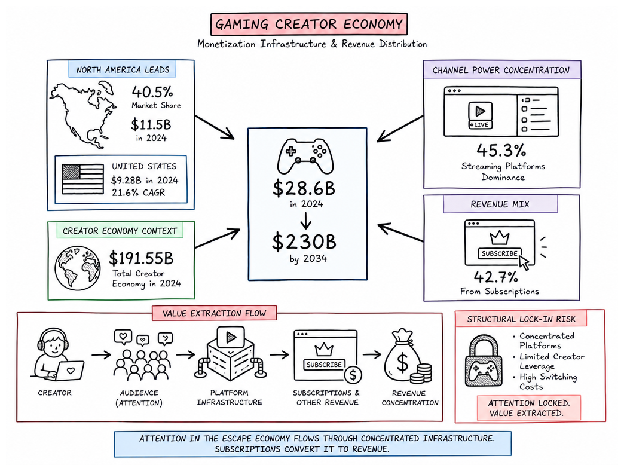
- $11.5 billion in 2024 — North America holds 40.5% of the gaming creator market, with the US alone at $9.28 billion growing at 21.6% CAGR
- Streaming platforms dominate channels at 45.3%, generating 42.7% of revenue from subscriptions — locking users in so tightly they can't see daylight
- Video game streaming, esports, AI-generated content, user-generated platforms — these are the actual growth engines
The gaming creator economy ($28.6 billion in 2024) is merely a scaffolding. The entire creator economy sits at $191.55 billion. Gaming isn't a vertical. It's the load-bearing wall everything else leans against.
Shopify-like tools let creators run their own storefronts and blur the line between entrepreneur and player. The question isn't "why do people spend time here?" It's "why would they ever leave?"
A person streaming and monetizing their presence with a creator storefront isn't a hobbyist. They're an entrepreneur that just happens to be streaming. The escape economy isn't just a product to consume. It's a way to produce — which shifts how and why people pay for things.
Why Do People Pay to Leave? The Demand-Side Case
Is this real? Are we looking at the tail end of a pandemic hangover, or something structural that won't reverse itself?
Nope. Enterprise XR adoption hasn't decelerated post-2022 — it's actually accelerated. Adoption sits at all-time highs and the infrastructure is entrenching further. Nobody seems to know how to stop it.
Sure, 80% of under-18s game. But adults are following. Game streaming, esports, immersive tourism — engagement is climbing across age groups. The screen-time generational switcheroo already happened while people argued about it. It's tough to change now.
The feeling. Always the feeling. Haptics, multi-sensory venues, narrative immersion — you're not buying hardware. Hardware is just the pipe. The drug is the sensation. The escape itself.
People always pay to be somewhere else when the world feels like it's coming apart. History proves it: spending on immersive and escapist media holds or grows as markets go down. Volatility breeds escape-seeking. Which is its own kind of signal.
Location-based XR, immersive tourism, live game events — some of the fastest-growing sectors in XR all sit at this intersection. It's a high-value space of speculative opportunity before the category is defined. This is where alpha lives.
Interpreting the Signal — How to Read the Escape Economy Forecast
Demand is baked in. People are going. The question is whether you're positioned to win from it.
When forecasters can't agree, stop treating it like noise. $261 billion to $1 trillion-plus by 2033? That's not sloppy analysis — that's a volatility signal. It's in sectors where forecasts wildly diverge that alpha accumulates. Where the suits haven't yet figured out the rules.
| Signal | What It Says | Why It Matters |
|---|---|---|
| $261B–$1T spread | Radical uncertainty in sizing | Opportunity indicated by forecaster disagreement |
| Consumer time already there | Adoption leading capital | Behavioral gap before positioning closes |
| Real friction + regulatory fog | Barriers to entry | Building moat in real time |
Consumer time is flowing. Capital is still parked. That gap is the whole thing.
Platform concentration, regulatory ambiguity, and hardware costs — that's friction. But that friction is the moat. It's a bug that's really a feature. Emerging speculative opportunities always look like problems until they don't.
How We'll Know if the Market Is the Exit
Immersive entertainment isn't a tech trend. It's a revealed consumer preference operating at civilizational scale. The $261B to $1 trillion trajectory isn't built on venture capital or silicon roadmaps. It's built on human behavior. On kids who'd rather be in a game than at a dinner table. On adults paying to feel something. And the structural demand drivers that fuel it? They don't reverse — they compound.
| Driver | Why It Matters | Reversible? |
|---|---|---|
| Digital-native generations raised on screens | Baseline expectation, not novelty | No |
| AI-powered experience design | Exponentially better at capturing time | No |
| Social fragmentation + time scarcity | People seeking belonging elsewhere | No |
The escape economy is a leading indicator for where attention-monetization infrastructure will develop. The reality people want to escape from doesn't have to be dystopian. They just have to find it less compelling than the other option. And right now? They absolutely do.
This is adharma: the age where old rules don't apply and the gods who wrote them aren't answering. The exit is the market.
25% of people in the metaverse daily by 2026.
Consumer time already there. Capital still parked.
Adharma is the only alpha that never lies. — Kalyug Capital