The Question Nobody Is Asking at Checkout
I've started asking friends: where's your head at right now when you hit that button? Not the moral question. The actual question. Because somewhere between "add to cart" and the moment your package lands on your doorstep, something shifted. We stopped waiting. And then we forgot what waiting even felt like.
Two hours. That's the window. Not a logistics milestone — a cultural one. A timestamp. And you accepted it without blinking. Fast commerce didn't serve impatience. It manufactured it.
Once upon a time, we really wanted things. But over the years, desire and need have collapsed into each other. No friction involved. One click. Two hours. Done. So large, expensive, and ever-on is the machine someone has built so you never have to understand the meaning of waiting for something you want. I can't help but wonder if this fact deserves more than just a footnote in your morning scroll. That infrastructure isn't just brutally engineered — it's relentlessly so.
So let's break this down: the machine itself — what it actually takes to promise you something in 120 minutes. What happens inside your brain — the psychological feedback loop that turns speed into need. And the price you pay — not in dollars, but in something quieter, something you won't notice until it's gone.
The Machine That Runs While You Sleep
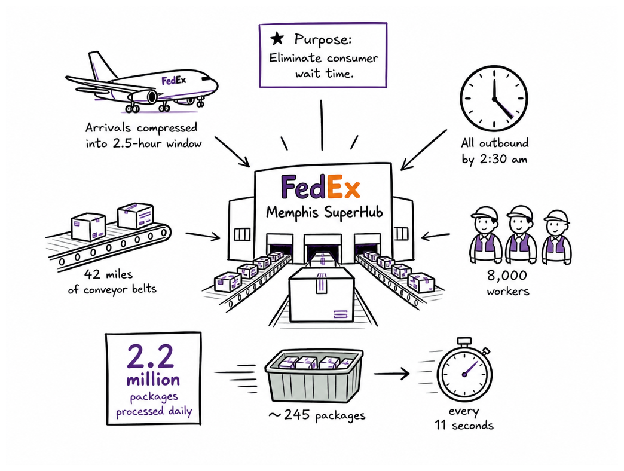
But here's the thing nobody talks about at checkout: there's no magic involved. Just infrastructure. Brutal, enormous, stupidly expensive infrastructure that operates 24/7 in a windowless warehouse in Memphis while you sleep. The FedEx SuperHub handles 2.2 million packages daily alongside nearly 8,000 workers working overnight — aircraft shuttling in runs so intense they look like military operations (they basically are), and it all works out so that the box you ordered at 11 pm arrives on your doorstep by noon the next day. No drama. No sweat. Just inevitable. And you didn't think twice about it, did you? Someone else's night disappeared so yours could stay uninterrupted.
On their own, these numbers demand attention. Aircraft arrivals compressed into a 2.5-hour window. Outbound by 2:30 am. One container — roughly 245 packages — entering the sort every 11 seconds. Someone stared at the bottleneck and said: nope, not around it, through it. They didn't optimize the constraint. They eliminated it. A vast, humming, always-on machine that costs billions to operate, staffed by workers sorting packages at speeds that would make your eyes water. All so you don't have to sit with want for twenty-four hours. And honestly, that stubborn refusal to let you wait is worth sitting with — because at this point, we've stopped asking whether we actually needed it in the first place.
Rewiring a Brain with One Click
Here's the deal with the Memphis SuperHub, or those 2.2 million packages getting moving at night like blood rushing through a vein: the infrastructure is meaningless if your customers don't want the product to begin with. So, the team had to solve a different problem. They had to make you want it faster — and make the gap between impulse and acquiring the product so small, it might as well be nonexistent.
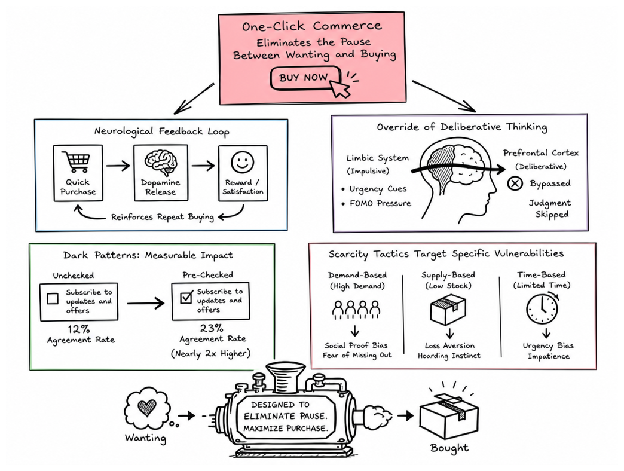
With one click, they got rid of the pause — the one where you'd think to yourself, "Do I actually need this?" Your dopamine hits. Limbic system floods. The prefrontal cortex gets crushed under urgency cues and manufactured FOMO. It's not a bug. It's the feature they paid engineers millions to build.
Once you begin to notice the dark patterns, they feel almost humorously obvious:
- Checked boxes that assume you want to agree to something you don't. (Agreement rates double when you opt-out instead of opt-in.)
- "Only 3 left in stock" when there are actually hundreds.
- "Limited time only" flashing in red, triggering an intense sense of scarcity panic.
- Countdown timers on offers that never actually expire.
Each targets a different crack in your brain. When you're emotionally invested, time-based scarcity works. When FOMO is the play, it's supply-based. And the real horror? These patterns increase choice inconsistency by 6–12 percentage points. You purchase things you don't want. Things that contradict what you told yourself you valued.
Just pixels. Engineered to make you stupid for thirty seconds. Which begs the question: what happens when you remove friction entirely? When speed becomes the only acceptable way to transact?
Speed as a Loyalty Trap
The buying process doesn't end with checkout. It also translates to loyalty programs built on one core principle: now beats later. These programs change the game by rewarding consumers immediately — an approach that results in 18% more spending, repeat visits, and a complete rewire of your habits before you know it. The platforms know exactly what they're doing.
And this is the feedback loop which is actually running:
| Stage | What Happens | The Result |
|---|---|---|
| Less friction | Strip away the pause. Kill the cart. One click and it's yours. | More purchases. More frequently. |
| More purchases | Transaction volume explodes. Data accumulates. Lock-in deepens. | Platform revenue skyrockets. |
| Higher revenue | Venture capital floods in. Competition demands frictionlessness. | Investment in removing even more friction. |
The issue of cart abandonment was "solved" by one-click checkout startups with valuations at $100M. The intensifying cycle goes back to baseline. But here's the thing: no one asks whether this was the problem that actually needed solving.
Gen Z is the canary. This audience never knew a world where buying required thinking. They experienced friction not for their protection, but as an external punishment. For them, the pause between want and purchase doesn't feel like a safety gate. It feels like a cage. And the platforms have trained them — trained us — accordingly.
Quick Commerce and the Shrinking Acceptable Wait
Speed used to be a feature. Now it's the baseline. And the baseline keeps getting shorter.
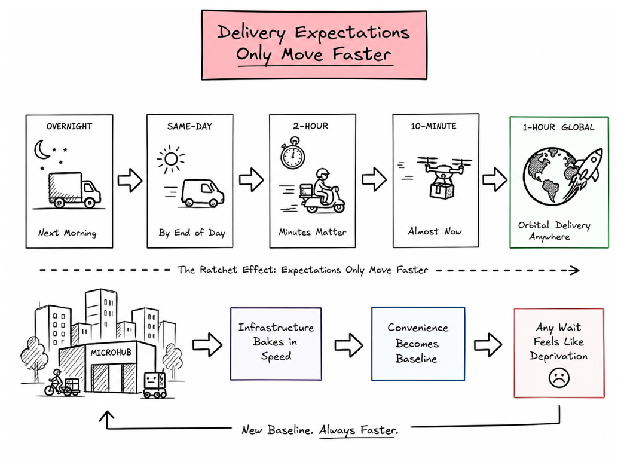
Overnight shipping was once the crown jewel — the thing you paid extra for when it mattered. Then same-day arrived and reset expectations. Then two-hour windows. Then ten minutes. Each iteration doesn't add value; it just erases the previous one. What was miraculous becomes invisible. What becomes invisible becomes required.
It's more than just logistics. It's the gap between wanting and having — shrinking so fast it starts to feel like a personal insult. Which is insane, right?
Compressing time looks like:
- Overnight delivery services (2000s)
- Same-day delivery services (2010s)
- Two-hour delivery options (late 2010s)
- Ten-minute delivery options (2020s)
- One-hour global delivery via orbital spacecraft (emerging, not metaphorical)
Microhubs aren't just warehouses strewn across the city. They're the built environment that physically embeds the pace of speed into urban infrastructure. The more fulfillment centers built, the deeper immediacy gets embedded. The math is relentless: faster becomes normal, normal becomes not enough, not enough becomes — somehow — an affront.
The ratchet effect suggests that expectations can only move in one direction. Once speed is normalized, it can't be taken away. You can't ask people to go back to two hours after they've had ten minutes.
Somewhere between overnight and orbital, we stopped asking if we actually wanted the thing, and instead started asking if we can have it now. That's the real compression. Not the timeline. The question itself.
Impatience's Infrastructure Has a Twin
The timeline keeps compressing. And the same mechanics that collapsed the wait between desire and delivery? They're operating in your trading account right now.
It's actually crossed my mind — how are 0DTE trades and one-click checkouts physically and neurologically distinct? Like we mindlessly scroll a digital landscape, see something we want, want it, click a button — and it's in our cart. One click. No friction. The gap between impulse and action has been engineered out of existence. Now flip that to the markets: you spot volatility, you spot an opportunity, you feel it, and your position fills before you've finished the thought.
The same adrenaline rush. The same limbic override. But with a totally different asset class.
- 3x leveraged ETFs that swing like fever dreams
- 0DTE options that expire in hours
- Positions opened and closed before lunch
- Regret arrives later — if it arrives at all
Both treat delay as a bug, not a feature.
Kalyug Capital lives on the same psychology: high risk tolerance, degen traders, alpha in the volatility, in the chaos, in the moments when the market seems crazy — arguably the only place alpha exists anymore. It didn't judge; it just knew exactly who it was building for.
At this point, we've all been gripped with speed as a moral framework. Because if you wait, you're leaving money on the table. If you wait, your package gets delivered in three hours instead of two. If you wait, the trade goes against you. The same current runs through both — commerce and capital, markets and retail. Same wiring. Different outlets. Same hunger for the next hit.
What Waiting For Things Does to You — and What You Lose When You Don't
But one question no one's stopping to ask as they stare at a delivery tracker: Does any of this actually make us feel better? (It doesn't.)
11 seconds between containers on the belt.
All so you don't have to sit with want for 24 hours.
The dopamine loop runs on overnight delivery and one-click checkout. Fast commerce isn't slowing down — it's the infrastructure of the impatient, and impatient is now the default human setting. The companies that own that infrastructure — the last-mile logistics stacks, the BNPL rails, the platform lock-in — those are the structural winners. Not you. Them.
The question isn't whether you'll keep pulling the lever. The question is whether you'd rather be pulling it or building it.
Adharma is the only alpha that never lies. — Kalyug Capital