I've started asking friends: where's your head at right now? Does the idea that an entire generation is systematically engineering their faces and bodies feel normal to you? Because it doesn't to me. It feels like we've all collectively decided the mirror isn't a reflection anymore — it's a command center. A to-do list. A problem.
Lookmaxxing is the term, and it's everywhere now — bleeding from niche internet forums into TikTok's mainstream bloodstream, into your cousin's group chat, into the pharmacy aisle where Ozempic lives. Softmaxxing is your skincare routine, your haircut, your gym era. Hardmaxxing is surgery. Bone smashing. Injectable everything. The gap between them used to feel enormous. Not anymore.
I'm not here to wag a finger about vanity. This is a secular consumer trend with real momentum, real money, and real consequences — and the tools to execute it have never been cheaper or more casual.
Ozempic alone is doing $20 billion in annual revenue.
That's not a trend. That's a permission slip. We've collectively decided — silently, almost accidentally — that the body is no longer something you're born with and accept. It's a project. A thing you tune, poke, inject, and iterate on like a piece of software that ships updates whether you're ready or not.
The cultural shift from passive acceptance to active self-modification is the real story here. Once millions of people are comfortable injecting synthetic compounds for aesthetics — once that psychological barrier collapses — everything downstream follows.
How Ozempic Rewired America's Relationship With Pharmacological Self-Improvement
The self-optimization impulse you already live — gym membership, skincare regimen, biohacking supplements — just got a pharmaceutical shortcut. What began as a diabetes treatment has become the most visible symbol of a cultural permission structure: pharmacological self-improvement is no longer a moral compromise, it's a legitimate strategy.
GLP-1 drugs work by suppressing appetite and signaling satiety directly to the brain. They're not willpower. They're not discipline earned through suffering. They're pharmacological efficiency — a tool that dissolves the distinction between "natural" optimization and "artificial" optimization into a single category: whatever works.
The stigma architecture is collapsing in real time:
- Social proof through scale: 1 in 8 adults using it means the person taking GLP-1 for cosmetics is no longer an outlier — they're part of a normalized cohort
- Off-label adoption among youth: Younger demographics never internalized the shame around medication-assisted body modification; for them, it's simply tool selection
- Rebranding from "cheating" to "optimization": The cultural conversation shifted from moral judgment to efficiency metrics
Once pharmacological intervention becomes routine for body composition, the conceptual barrier to other chemical enhancements — peptides, bioidentical hormones, performance compounds — erodes significantly.
Ozempic Opened the Door — and Left It Wide Open
Ozempic was never just a weight drug. It's a synthetic GLP-1 receptor agonist — a precision tool that hijacks your appetite signals, rewrites your relationship with food. And we're still cataloging what else it's doing in there.
| Drug | Mechanism | Stakes |
|---|---|---|
| Semaglutide (Ozempic) | GLP-1 receptor agonist | Appetite suppression, "Ozempic face" |
| Retatrutide | Triple receptor agonist (GLP-1 + GIP + Glucagon) | Faster fat loss, compounding side effects |
"Ozempic face" — sudden, dramatic fat loss across the cheeks and jawline — started appearing in people's feeds like some involuntary aesthetic experiment. Your face wasn't supposed to do that. But it did. And when millions of people are watching their own faces hollow out from a drug technically designed for blood sugar management? The line between "medication" and "body modification" gets smudged. Permanently smudged.
Then retatrutide entered the chat — triple receptor hit, way more aggressive tissue remodeling, fat loss that makes semaglutide look like a starter kit. The escalation has no floor. Which is exactly the problem, and exactly why people are lining up for it.
Mass adoption of GLP-1 didn't just normalize injectable drugs for aesthetics. It collapsed the psychological barrier to peptides entirely. Once your neighbor is injecting something weekly for appearance, suddenly peptides don't feel fringe anymore. They feel inevitable.
Lookmaxxing: From Incel Forums to TikTok's Main Stage
It started in the corners. The dark corners. 2010s incel forums where dudes were literally measuring jawlines and theorizing about bone structure like it was the secret to existence. Then something happened — the internet got bored with gatekeeping. TikTok arrived. And suddenly lookmaxxing wasn't niche anymore. It was everywhere.
The trinity is always the same: jawline, skin, muscularity. But the line between softmaxxing and hardmaxxing? It's dissolving fast.
| Softmaxxing | Hardmaxxing | The Blurry Middle |
|---|---|---|
| Skincare, haircuts, gym work | Surgery, fillers, bone smashing | Prescription weight loss for aesthetics |
| Self-care language | "Maximization" language | What do we even call this? |
| Accessible | Expensive, risky | Both, increasingly |
When Merriam-Webster added "looksmaxxing" to the dictionary, that wasn't just linguistic. That was cultural surrender. The gatekeepers threw up their hands.
We're talking about a $106bn beauty market — and it just got a prescription pad.
Ozempic Opens the Gate — Retatrutide Blows It Off the Hinges
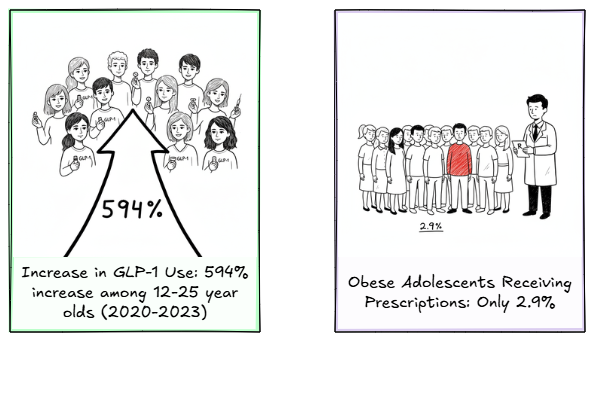
Nearly six times as many young people. In three years.
Only 2.9% of obese adolescents had prescriptions in 2024. Most of the kids using GLP-1s aren't medically obese. They're not there because their doctors said "you need this for your health." They're there because they saw the results and decided their body wasn't good enough yet. That's aesthetic adoption, not medical necessity. That's lookmaxxing with a prescription pad.
| Ozempic / Wegovy | Retatrutide | |
|---|---|---|
| Mechanism | GLP-1 only | GLP-1/GIP/glucagon (triple) |
| Primary Effect | Appetite suppression | Appetite + fat loss + muscle retention |
| Status | FDA-approved | Clinical trials (not yet available) |
Gen Z? 53%. They're voting with their wallets.
The Peptide Underground Goes Mainstream
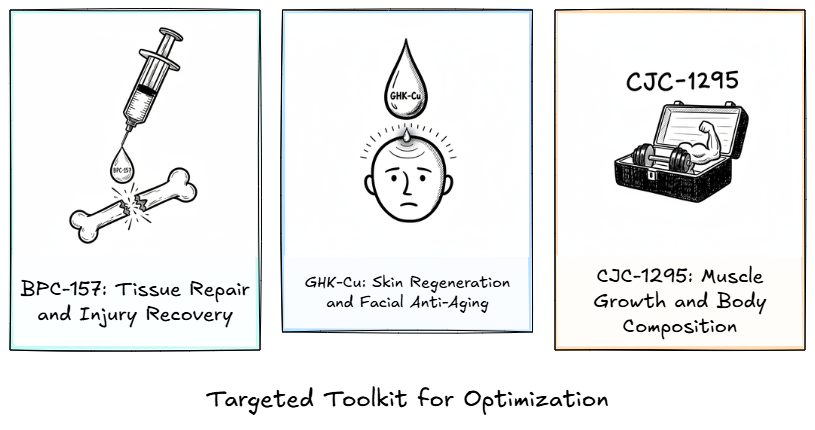
The truly obsessed didn't wait for Ozempic to go mainstream. They've been running their own experiments in the regulatory grey zone, stacking compounds that aren't FDA-approved for aesthetic use. Welcome to peptides. Welcome to lookmaxxing's unregulated frontier.
BPC-157 — The Fix-Everything Peptide
Tissue repair, gut health, inflammation reduction. Gym rats recovering from torn labrums and wrecked knees have been running this for years. You inject it, your body starts patching itself. The compound you reach for when you need to be functional again, fast.
GHK-Cu — The Face Peptide
A copper-binding anti-aging tripeptide that naturally declines with age. Collagen production, skin regeneration, the whole aesthetic play. Already crossing over into mainstream beauty formulations — the barrier between underground optimization and consumer product is dissolving in real time.
CJC-1295 — The Body Composition Play
Growth hormone-releasing peptide. Muscle growth, fat loss, recovery, sleep. CJC-1295 is what happens when you realize longevity and looking good are basically the same project. The truly committed stack it with Ipamorelin. Either way, it separates the aesthetically serious from the casually curious.
The FDA hasn't said yes. Hasn't said no. Just... nothing. And the community has taken that silence as permission. Underground protocols have been tested, refined, stacked in ways that would make a pharmaceutical research team blush. The frontier is becoming the floor.
This Isn't a Trend. It's a Secular Shift.
The numbers don't lie.
- Global wellness market: $2 trillion
- US alone: $500 billion, climbing at 4–5% annually
- Beauty growing at 6% per year through 2028
- Skin care specifically: 3.17% CAGR through 2031
- People were losing their houses in 2008 and still buying vitamins. Vitamins grew 6% that year.
This market is recession-resistant because it's fundamental. 84% of US consumers say wellness is a top priority. 60% cite healthy aging specifically. That's not trend data. That's a values shift. People are reorganizing their entire spending around the idea that they can engineer themselves into better versions.
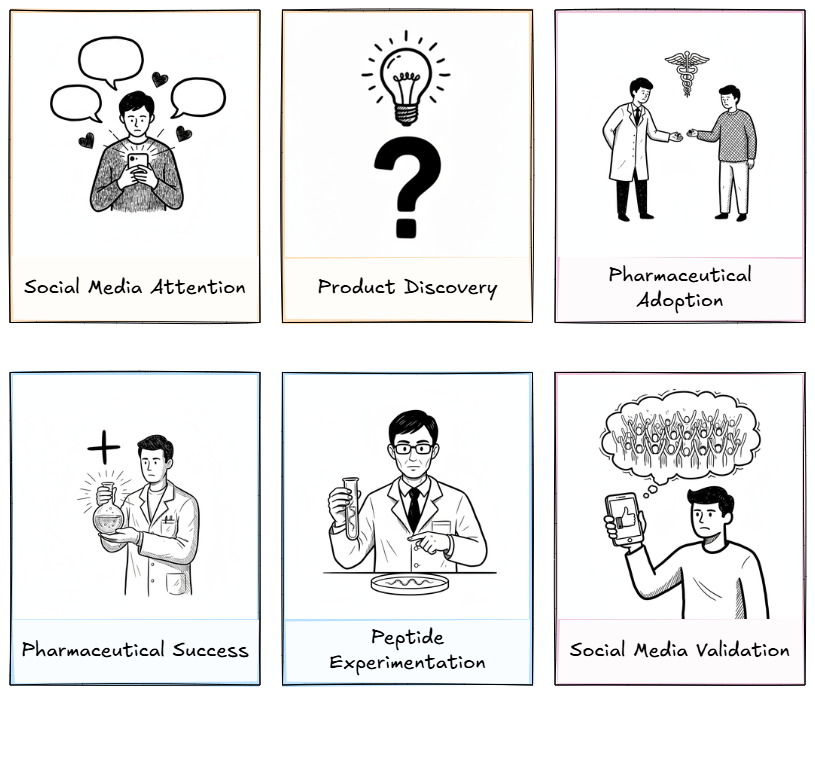
Social media attention creates product discovery. Product discovery drives pharmaceutical adoption. Pharmaceutical adoption leads to peptide experimentation. Peptide experimentation goes back to social media. The flywheel feeds itself. Every loop pulls more money in. Every loop pulls more people into the game.
Vanity has always been a market. Now it has a PhD.
The infrastructure is already there. The demand signal is screaming. What's missing is anyone willing to bring order to the chaos — brand trust, quality control, a subscription model that doesn't feel like buying research chemicals from a guy named Kevin. Someone's going to weaponize that opportunity. And when they do — when they turn the peptide underground into a platform — the entire lookmaxxing economy shifts into overdrive.
Whoever figures it out first owns the whole stack within a decade. Not just weight loss. The subscription to:
- Looking at yourself without flinching
- Skin that doesn't betray you
- The version of yourself that feels right when the mirror catches you
The mirror's already crowded.
The question is: who's selling the reflection it wants?